The Real Reason Providers Like DO/Linode/Vultr Are Losing Ground in 2025
Last month, a CTO I advise showed me something surprising.
Her 12-person startup had just completed a migration. Not to AWS. Not to GCP. They moved off DigitalOcean—the platform that had served them faithfully for three years—to a combination of Railway for their backend services and Hetzner for their GPU workloads.
"We're paying less and shipping faster," she said. "Why didn't we do this sooner?"
That conversation crystallized something I've been observing across dozens of companies: the mid-tier cloud providers that defined the 2015-2020 era are facing an identity crisis. And it's not about performance.
Why This Matters
DigitalOcean, Linode, and Vultr built empires on a simple promise: AWS power without AWS complexity. Developer-friendly interfaces. Predictable pricing. No enterprise sales calls.
That promise worked beautifully—until the market evolved.
Here's the uncomfortable reality: the VPS market isn't shrinking. It's projected to grow from $3.5 billion to $7.1 billion by 2031. But the growth is happening around these providers, not through them.
DigitalOcean's stock tells part of the story. Revenue growth slowed from 30% in early 2023 to 12% by 2024. Their low-spend customer base—the indie hackers and early-stage startups that made them famous—declined 3-4% quarter over quarter. A CEO change followed.
Linode got acquired by Akamai for $900 million in 2022. The integration has been… complicated. Long-time users who loved the "here's a Linux box, have fun" simplicity now navigate enterprise-focused messaging about edge computing synergies.
Vultr remains independent but increasingly invisible in developer conversations.
What happened?
The Three Forces Reshaping Developer Infrastructure
1. The Rise of "Zero-Server" Platforms
Here's a confession: I've set up VPS servers hundreds of times. The ritual is burned into muscle memory—SSH in, update packages, configure nginx, set up SSL, deploy code, configure monitoring, pray nothing breaks at 3 AM.
I'm tired of it. So is everyone else.
Platforms like Railway, Render, and Fly.io didn't just simplify deployment. They eliminated an entire category of work.
"Connect your GitHub repo, hit deploy, and your backend is live in minutes."
That's not marketing copy. That's the actual experience. Railway reports that teams using their platform save 18+ hours per sprint just on infrastructure tasks.
The math is brutal for traditional VPS:
| Task | VPS Time | PaaS Time |
|---|---|---|
| Initial server setup | 2-4 hours | 5 minutes |
| SSL configuration | 30-60 minutes | Automatic |
| CI/CD pipeline | 2-3 hours | Built-in |
| Scaling | Manual, hours | One click |
| Security updates | Ongoing | Managed |
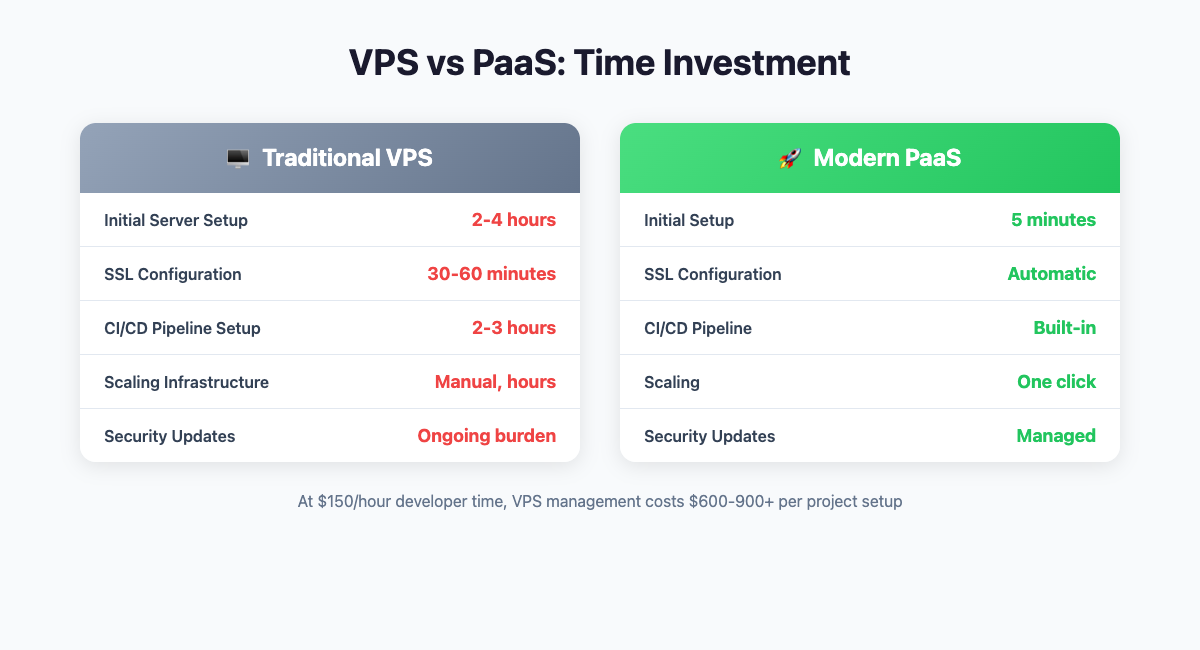
When developer time costs $100-200/hour, that "cheap" $20/month VPS suddenly looks expensive.
2. The Hetzner Effect
While DigitalOcean and Vultr competed on developer experience, a German company quietly became the value champion.
Hetzner offers equivalent specs at 50-70% lower prices. A comparable instance to DigitalOcean's $48/month droplet costs roughly €15/month on Hetzner. The performance is often better—AMD EPYC processors with 5-10% faster single-core performance in benchmarks.
The catch? Limited regions (Germany, Finland, US, Singapore) and no managed services.
For teams that know what they're doing, that's not a catch—it's a feature. They don't need managed Kubernetes. They need cheap, powerful compute.
"Hetzner is the cheapest option of all major providers, making it great for projects that don't need complicated infrastructure."
Combine Hetzner with Coolify—an open-source, self-hosted PaaS—and you get Railway's developer experience at VPS prices. Best of both worlds.
This pattern is growing. Boot a Hetzner server, install Coolify, connect your GitHub repos, and you have a professional deployment pipeline for under €10/month.
3. The Acquisition Hangover
Linode's story deserves special attention because it's a cautionary tale about what happens when developer-first companies get absorbed by enterprise giants.
Akamai bought Linode to build an "edge computing powerhouse." The integration preserved Linode's brand but shifted its identity. Marketing now emphasizes enterprise synergies over indie developer needs.
Long-time customers noticed:
"I chose Linode specifically because of its simple, developer-friendly, no-frills setup. Now that risks being overshadowed by Akamai's overarching objectives."
Price increases followed the acquisition. Reddit and Linode's forums filled with users discussing alternatives. The "growing bitterness" that one report documented isn't about any single change—it's about the feeling that the company no longer sees them as the primary customer.
DigitalOcean hasn't been acquired, but faces similar pressure. Wall Street wants growth. Growth means enterprise customers. Enterprise focus means complexity that alienates the developers who built the brand.
The Developer Infrastructure Decision Matrix
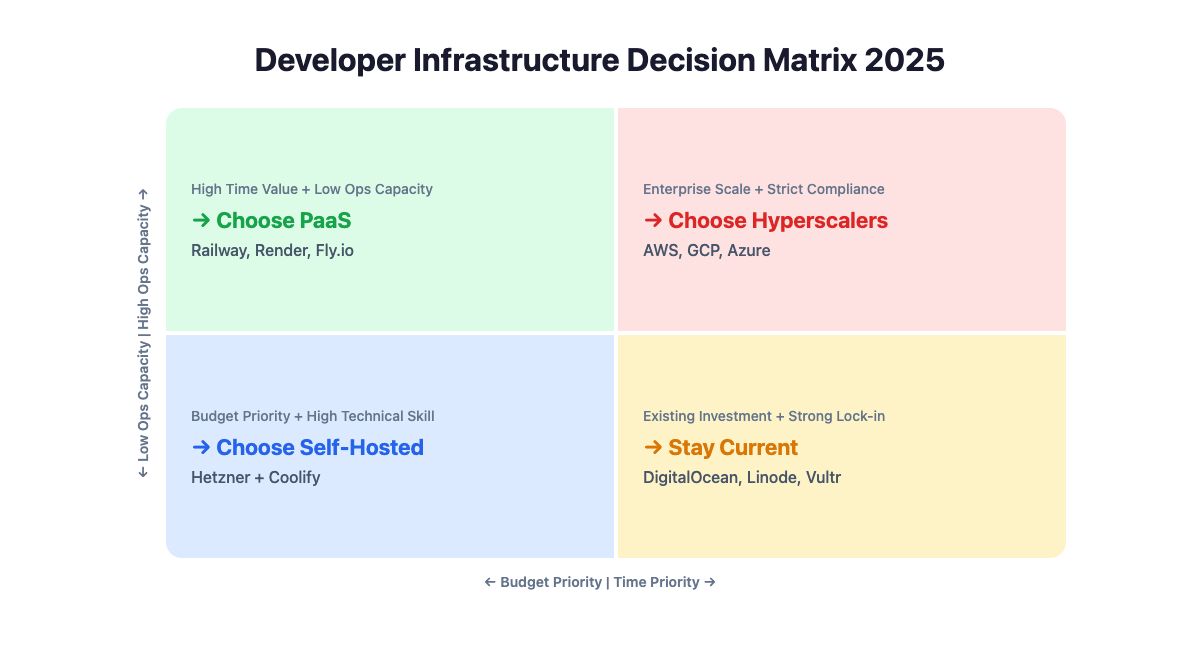
Here's the framework I use when advising teams on infrastructure choices:
[Developer Time Value] → High + [Ops Capacity] → Low = PaaS (Railway, Render)

[Budget Priority] → High + [Technical Skill] → High = Hetzner + Self-hosted

[Existing Investment] → High + [Ecosystem Lock-in] → Strong = Stay with DO/Linode

[Scale Requirements] → Enterprise + [Compliance] → Strict = Hyperscalers (AWS, GCP)
Choose Railway/Render/Fly.io when:
- Developer time is your scarcest resource
- You need to ship fast and iterate faster
- Your team is small (under 15 engineers)
- You're building prototypes or MVPs
Choose Hetzner + Coolify when:
- Budget matters more than convenience
- You have at least one infra-comfortable engineer
- Your users are primarily in Europe
- You want control without vendor lock-in
Stay with DO/Linode/Vultr when:
- You have significant existing infrastructure
- Your workflows are already optimized
- You need managed databases without hyperscaler complexity
- Geographic coverage matters (DO has 15+ regions)
Go to AWS/GCP when:
- Compliance requirements demand it
- You need services these providers can't match
- You're at true enterprise scale
The Anti-Patterns I'm Seeing
1. Loyalty Without Re-evaluation
"We've always used DigitalOcean" isn't a strategy. Run the numbers annually. A team spending 10 hours monthly on server management at $150/hour effective cost ($1,500) might save money on a $50/month PaaS plan.
2. Over-Engineering with Kubernetes
Not every application needs K8s. I've watched startups spend months setting up Kubernetes on DigitalOcean when Railway would have had them deployed in an afternoon.
3. Ignoring the Hetzner Option
American companies reflexively dismiss European providers. Don't. Hetzner's US regions work fine, and the cost savings are substantial. Test before you dismiss.
4. Treating Infrastructure as Set-and-Forget
The infrastructure landscape shifts faster than most teams realize. What made sense in 2022 might be costing you in 2025. Schedule quarterly infrastructure reviews.
What the Future Looks Like
The VPS providers aren't going away. The market is still growing at 8.6% CAGR. But the growth is bifurcating:
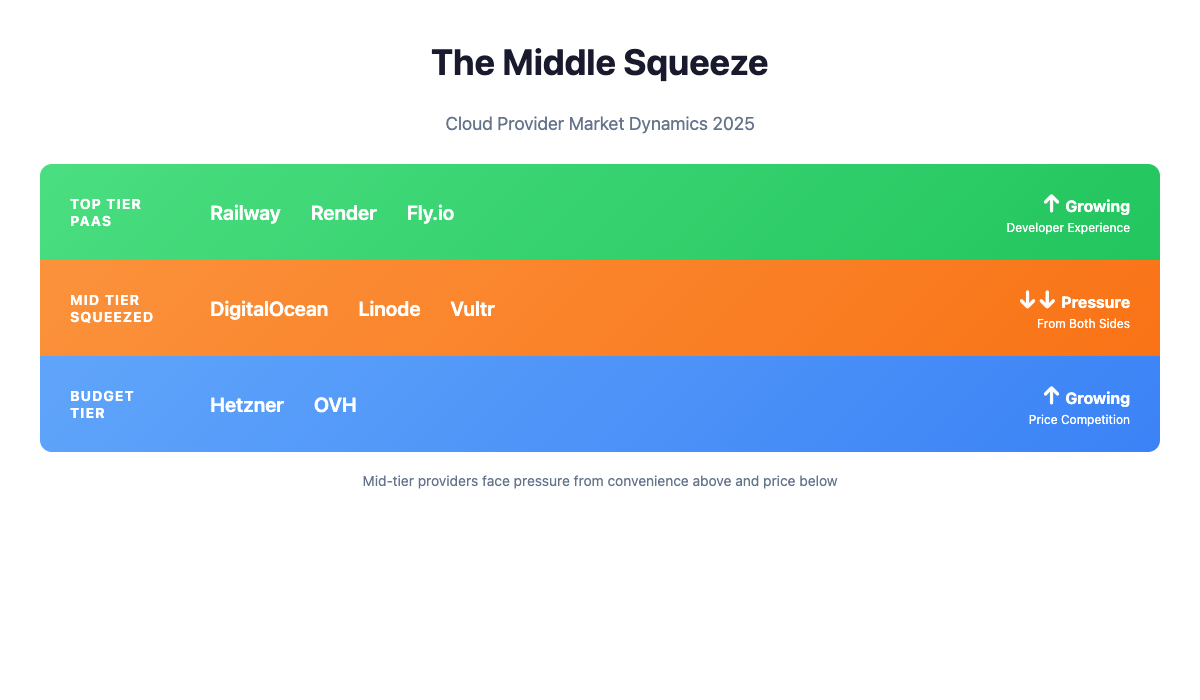
Managed services will dominate the high-end. Developers increasingly expect managed databases, automatic scaling, and zero-downtime deploys as baseline features—not premium add-ons.
Raw compute will commoditize at the low-end. Hetzner, OVH, and similar providers will continue squeezing margins. The "value" tier will become even more price-competitive.
The middle is getting squeezed. DigitalOcean, Linode, and Vultr occupy increasingly uncomfortable ground—more expensive than Hetzner, less convenient than Railway.
The survivors will need to pick a lane. DigitalOcean's AI/ML push suggests they're betting on specialized compute. Linode/Akamai is chasing edge computing. Vultr… remains to be seen.
The Builder's Takeaway
Here's what I tell teams wrestling with this decision:
Stop thinking about servers. Start thinking about shipping.
The question isn't "which VPS provider has better specs?" The question is: "What infrastructure choice lets us deliver value to customers fastest?"
For most startups in 2025, the answer isn't DigitalOcean, Linode, or Vultr. It's either:
- Up-market: Railway, Render, or Fly.io for maximum velocity
- Down-market: Hetzner + Coolify for maximum efficiency
The middle ground that defined the last decade is eroding. Not because these providers failed—they didn't. The market simply evolved around them.
The best infrastructure decision is the one you spend the least time thinking about.
Your next move: Calculate your team's actual infrastructure time cost this month. Include setup, maintenance, debugging, and on-call hours. Compare it to equivalent PaaS pricing. The results might surprise you.